Mt Bromo, You Were Worth Getting Up For.
It's just past 2.00 am on a Saturday morning. It's dark, it's cold, and it's beginning to rain!
I am blindly wandering the street outside the Jiwa Jawa hotel in search of the Land Cruiser Jeep ( circa 1983 ) that I was assured would be waiting for me, but clearly isn’t!

Roaring past me at reasonably high speed is a steady stream of jeeps of the same vintage, weaving their way up the slopes, transporting those who, like me, have come to see Mt Bromo at sunrise.
And then, out of the darkness, my driver Joko emerges, a diminutive mountain dweller who has been ferrying tourists up this mountain for over twenty years. Within minutes, we find our allotted slot in the cavalcade and begin our assent heading for the lookout point on Mount Penanjakan.

Mount Bromo rises from a vast sea of sand in the middle of the 10-kilometre-wide Tengger caldera and, at 2,392 metres above sea level, isn't even Java's highest peak. That title belongs to the 3,676m-tall Mount Semeru, that towering appendage that lurks in the background like a menacing bully, spewing thick volcanic smoke thousands of feet into the atmosphere.

However, while Mt Bromo lacks in stature, it is a veritable giant in religious significance. Its name derives from the Javanese pronunciation of Brahma, the Hindu creator god recognised as a fiery deity. It is one of the most active volcanoes in Indonesia, a country where eruptions occur almost every day.
The mountain has been revered by the local Hindu villagers for centuries, who make yearly pilgrimages to its smoky crater during the Yadnya Kasada festival, bestowing offerings at the Pura Luhur Poten temple at the volcano's base to try and keep the mountain's fury at bay.
The best views of Bromo and the surrounding caldera are from the adjacent Mount Penanjakan lookout point – preferably at sunrise. This is the perfect time of day, when the early-morning warm light bathes the caldera in a kaleidoscope of vibrant colours of purple and orange that creates the kind of mythical scene that actually justifies rising at the ungodly hour of 2.00 am.

My sturdy jeep makes the forty-five-minute drive to the top in no time at all, which is surprising given the thick traffic and our painfully slow passage through the tiny villages hugging the side of the mountain. Most, if not all, of the inhabitants of these precarious settlements are up and about, selling all manner of clothing to ward off the chill, as well as preparing hot coffee and hearty breakfasts at small warungs (roadside stalls) along the route.

Eventually, we reach a point where we can go no further as the road is crammed with hundreds of Land Cruisers. Getting out and back down the mountain will be like playing Tetris. It is just past 3.45 am, with sunrise scheduled for 5.30 am, so a two-hour wait looms. The inky blackness shows no hint of stars, although I can detect low swirling clouds hovering not far above me.
This could be a wasted trip.
By this time, thousands of Indonesian visitors are slowly making their way up the road to the summit, where I am told the views will be best. Not feeling confident, I join this tide of humanity and eventually branch off onto a muddy path that leads to the caldera ridge.

Then, along with my rugged-up companions, we wait.
I am not sure what to expect, given that the visibility from my elevated spot is barely twenty feet, but I live in hope and settle in, listening to the low murmur of chatter surrounding me.
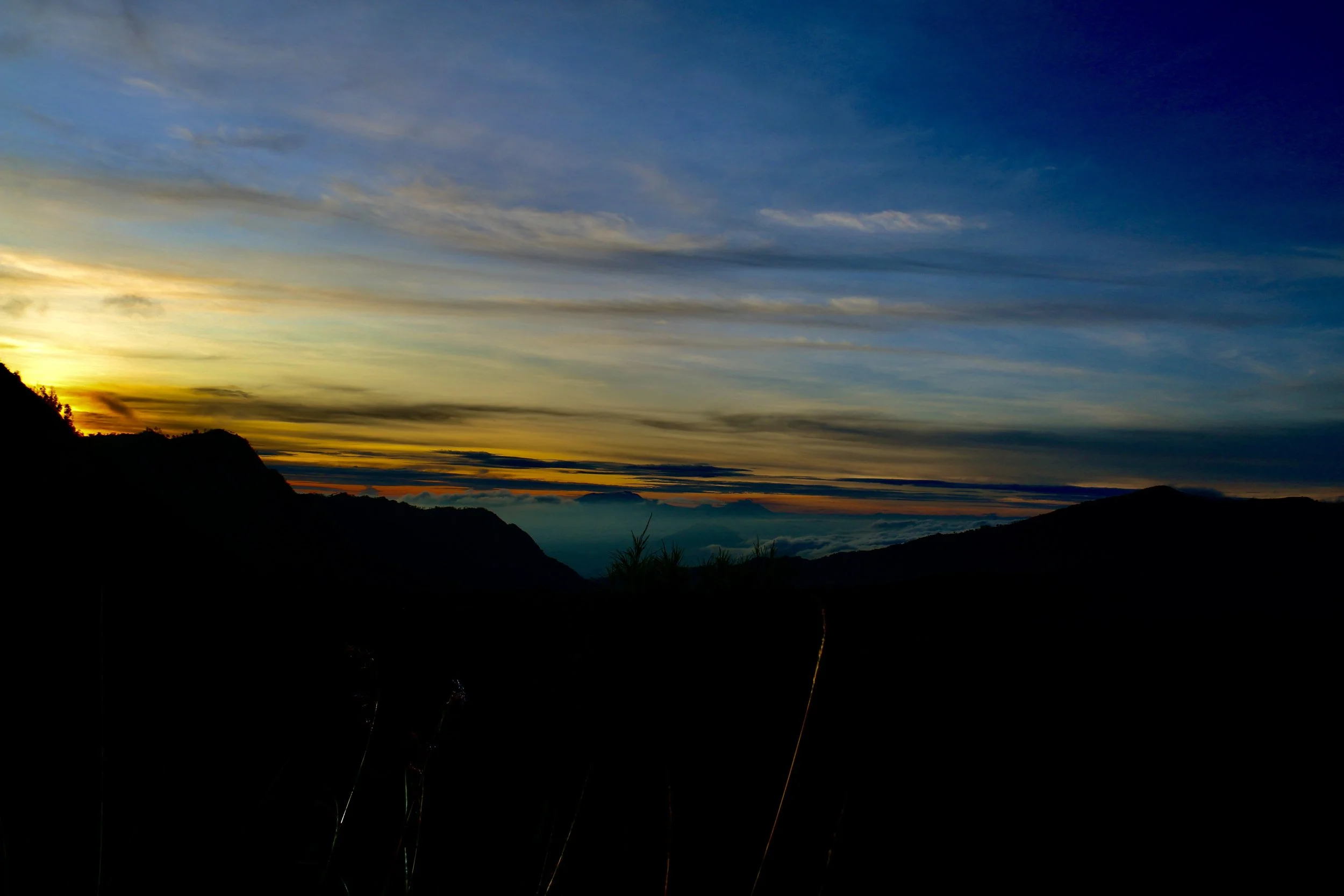
At about 5.00 am, the blackness slowly turned to a dark grey gloom emitting enough light to show that the low-lying clouds were lifting! Then, about fifteen minutes later, the sun rises over the Javanese horizon, and the magic begins. The low-lying clouds are the first to catch the light, and all at once erupt into iridescent shades of red, pink and orange.

It's as if some giant hand had suddenly pulled a curtain aside, as the valley slowly begins to glow and the shadowy outlines of the mountains come into focus. Within minutes, the entire vista is bathed in the glorious light of a sun that has illuminated it from an iridescent blue sky.

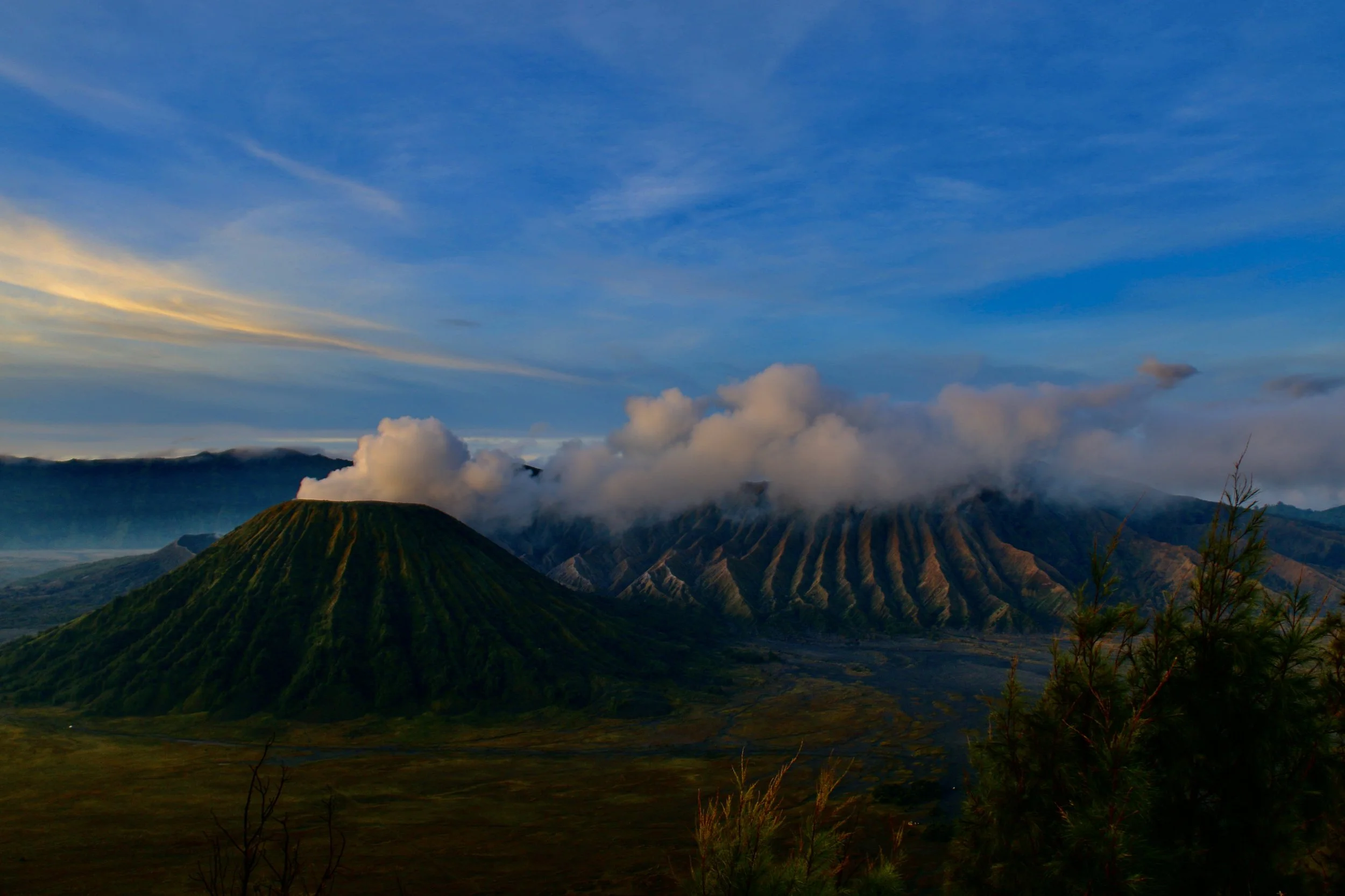
In front of me, hidden until that moment, is the surreal sight of the volcanic smoke from Mount Bromo drifting eastward like low-lying fog. The plumes swirl past the crinkly surface of Mt. Batok, a dwarfish, inactive volcano whose diminutive stature does nothing to diminish the scene.
The ancient crater has suddenly come alive, revealing a palette of charcoals, browns, greens and blues arranged as if set up for a painting by a Dutch Master. I had waited years for this moment, and even though I had seen it countless times in photographs, nothing prepared me for its captivating beauty.
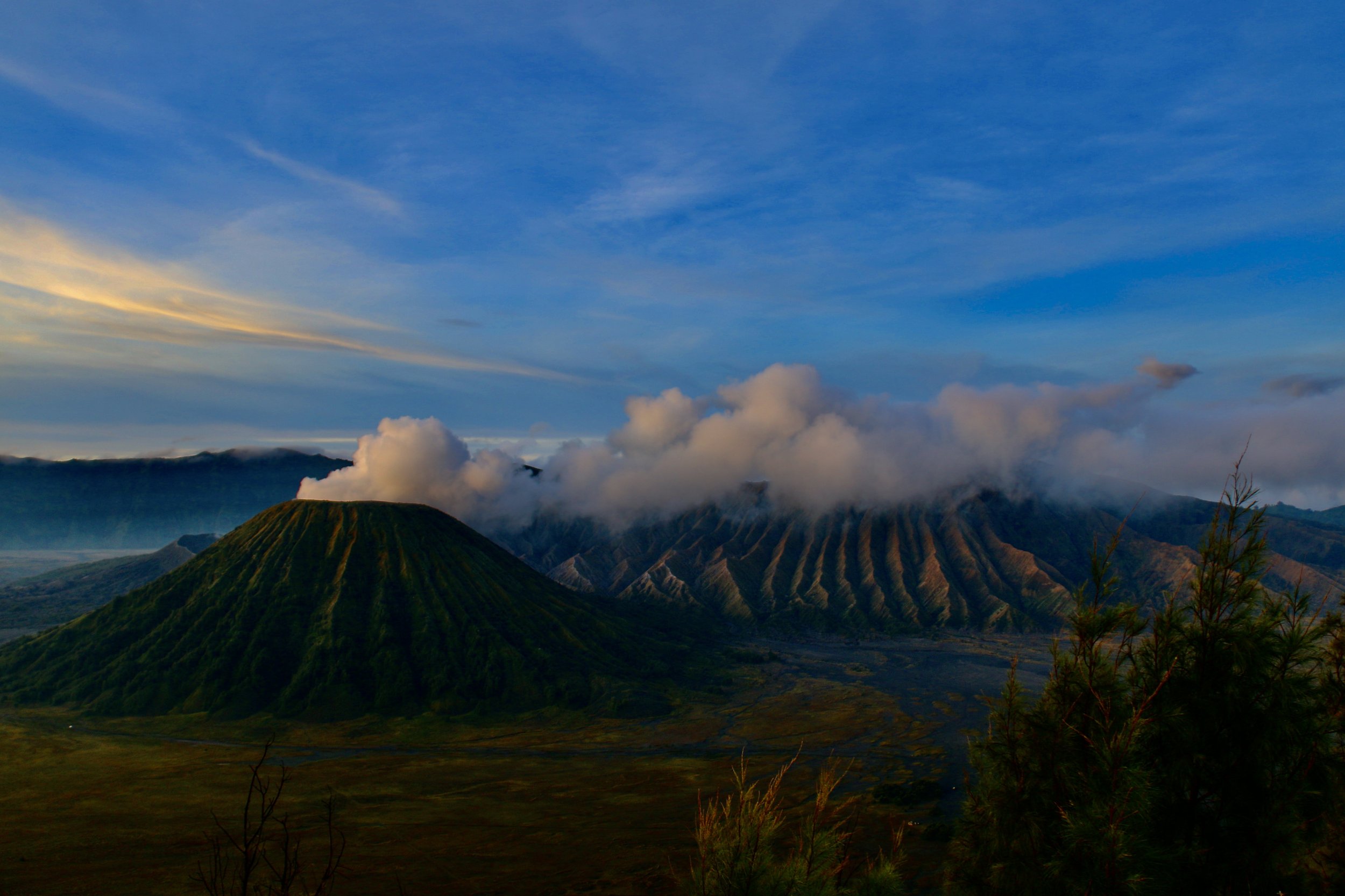
This stunning sight lasts barely five minutes as the sun's rays get brighter and the colours recede into more muted tones. The show over, it is the cue for the crowds to head back down the muddy path and seek out their jeeps, to take the long journey down the mountain on foot. Reluctantly, I leave my spot and follow them.

Joko, my ingenious driver, has somehow managed to turn my jeep around so it is now facing the right direction, meaning getting out is a breeze, and in no time at all, we are whizzing downhill to the caldera floor and the immense sea of sand.
The landscape at this level is devoid of the lush greens of the volcano's slopes, and the sand in all directions is a barren grey. In fact, the only colour is provided by the brightly dressed 'cowboys' galloping across the sand from the base of the crater a kilometre away. These equestrians are eager to rent their steed to any tourist who will pay the asking price.

I decided not to take a horse ride or, indeed, climb the 256 steps to the crater's rim (one volcano in the preceding week was enough for me!), opting instead to rest within the walls of the Hindu Pura Luhur temple at the base of Bromo to take in everything I experienced that morning.
As I sit there, I am once again reminded that the world is truly an amazing place.
Paul v Walters is the author of several novels and anthologies of short stories. His latest offering, RITUAL, was recently launched at the International Ubud Readers & Writers Festival.
Updated Jogjakarta, Indonesia, July 2026